The Baltic AI Landscape Update 2026
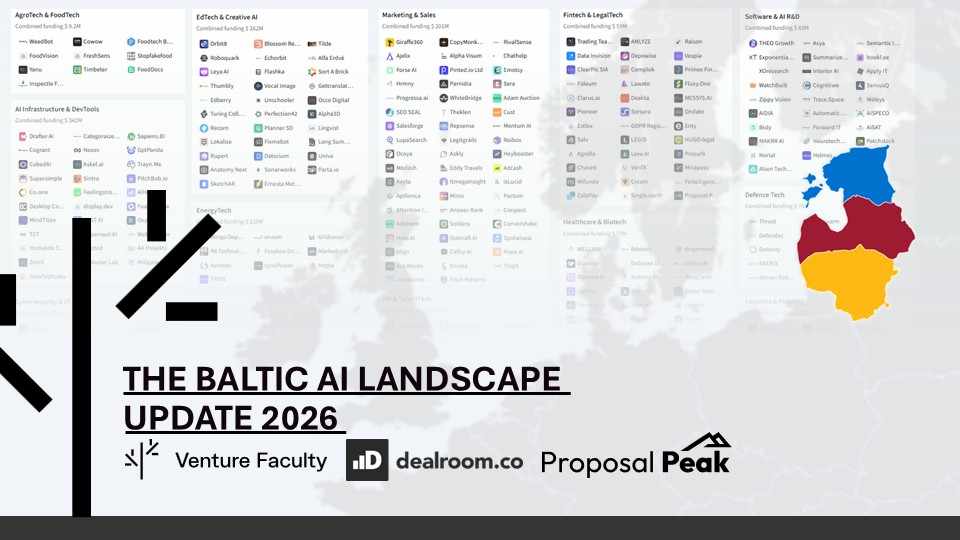
Venture Faculty, in collaboration with Dealroom, continues to track AI-powered companies across the Baltic region - businesses either headquartered here or maintaining a meaningful presence, all delivering AI-driven solutions or capabilities to their customers. Spotted an omission or something out of date? We welcome corrections, and any company is free to flag updates to its own listing directly.
Artificial intelligence continues to expand its footprint across industries. Some ventures are being built from the ground up around AI, while established players are folding AI into what they already offer, determined not to fall behind in a market that keeps shifting.
This year's landscape maps 282 AI companies across the three Baltic states - up from 184 a year ago, growth of just over 53% in a single year. Reaching that figure meant adding 115 companies and excluding 17 that had wound down or moved outside the methodology.
Methodology
This landscape includes only companies that provide AI-powered products or services to clients. Businesses that use AI solely for internal operations are not part of this database. The goal is to map how AI is being built into actual offerings across various industries. The full company list is maintained with Dealroom and is available here.
Companies are organized by two main factors: industry category and AI subcategory, inspired by NFX's The 5-Level AI Spectrum. The industry category reflects the sector in which the company operates - such as Logistics & Mobility, Cybersecurity & IT, or Sales & Marketing. The subcategory shows how deeply AI is integrated into the product or service.
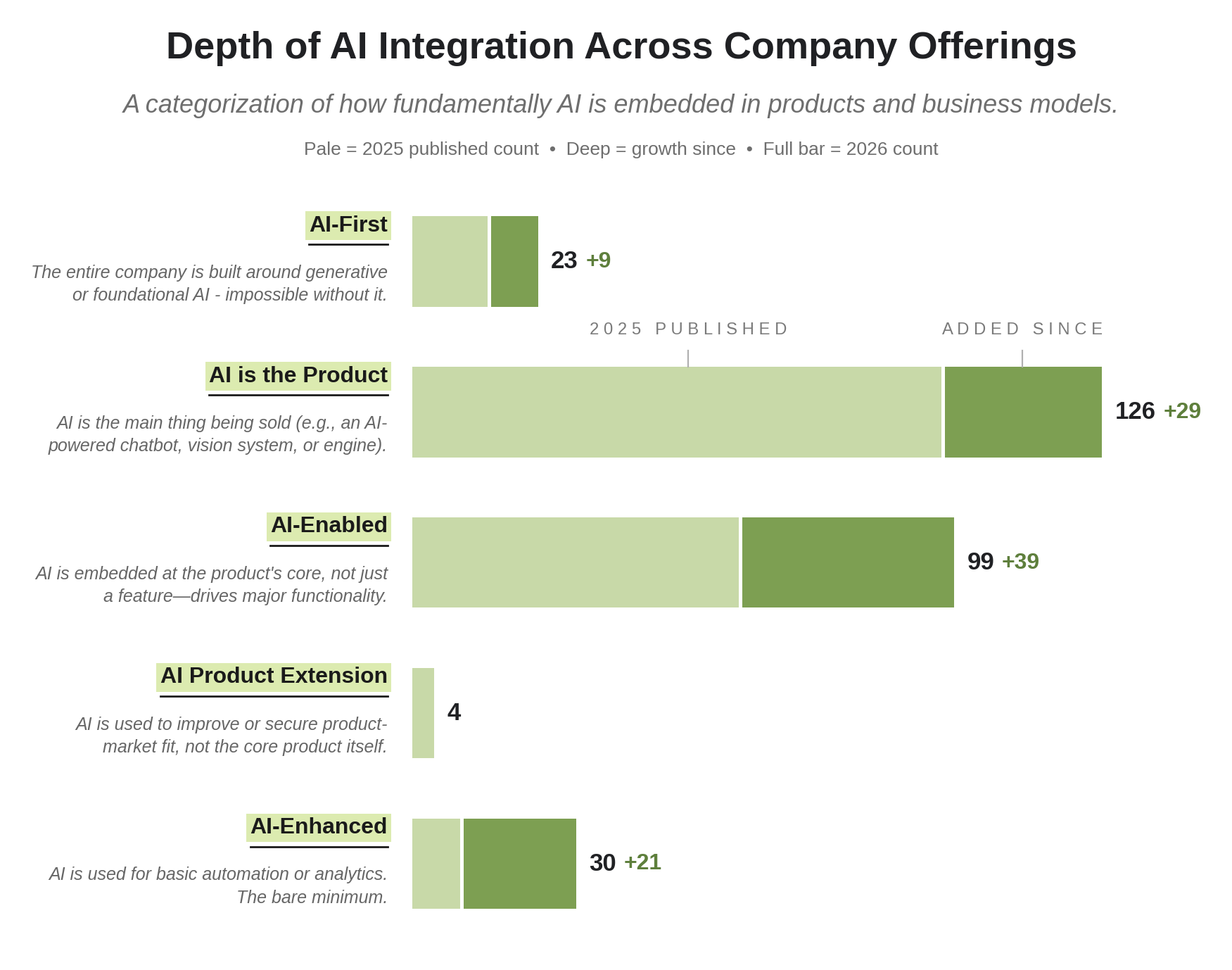
As was true last year, the majority of Baltic AI companies continue to build AI as a central part of their offering rather than a supportive add-on - 225 of 282 companies (80%) fall into either “AI is the Product” (126, up from 97) or “AI-Enabled” (99, up from 60). That share has slipped, though: the same two categories accounted for 157 of 184 (85%) last year. The reason is the AI-Enhanced category, which more than tripled from 9 to 30 - the fastest-growing level of integration in the landscape, and a sign of established, non-AI-native companies bolting AI onto existing products. AI-First grew more modestly, from 14 to 23, while AI Product Extension is unchanged at 4 companies, a rounding error two years running.
Deep Analysis of Data
The three countries differ in more than size - each leads a different sector and sits at a different depth on the AI spectrum. The charts below cut the same 282 companies by country, by sector, and by depth of AI integration.
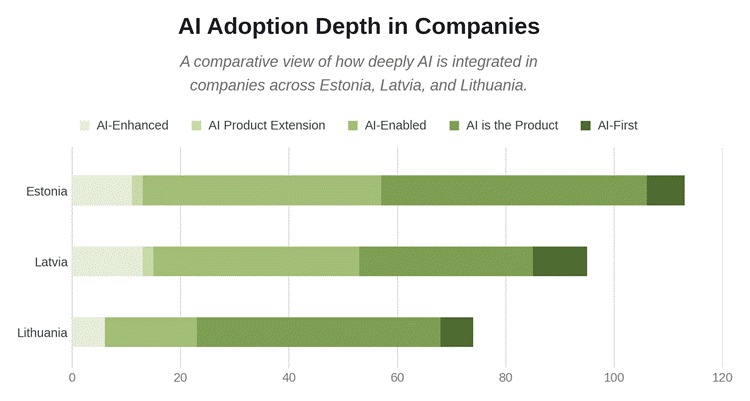
Across the region the split is uneven. Estonia leads with 113 companies, followed by Latvia with 95, and Lithuania with 74. All three grew sharply against last year's published counts of 76, 67 and 41 - Estonia by 49%, Latvia by 42% and Lithuania by 80%, the fastest relative growth in the region and very nearly a doubling. The ordering is unchanged, but the gap has widened at the top and narrowed at the bottom: Estonia now accounts for 40% of the region's AI companies, Latvia 34% and Lithuania 26%.
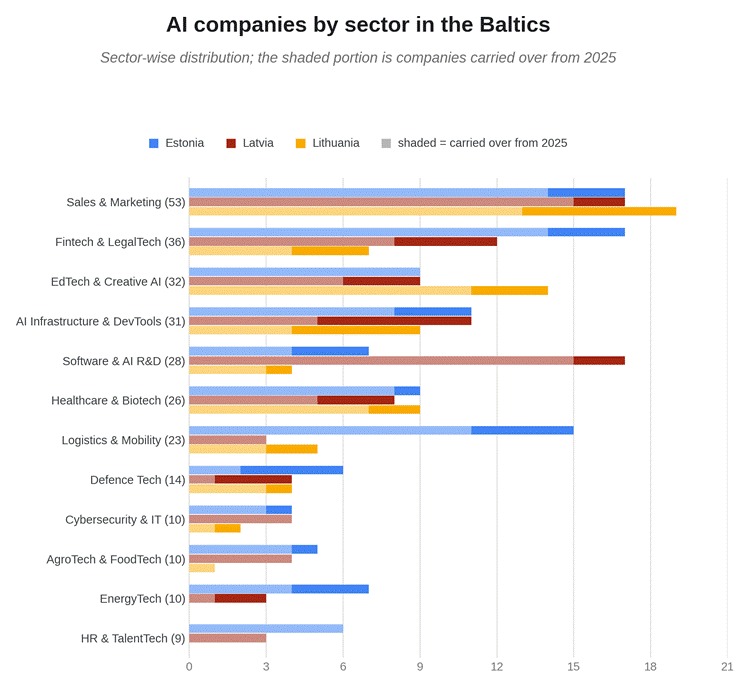
Estonia is the largest ecosystem in the region and the broadest: it holds or shares the top count in nine of the twelve sectors, and no single sector accounts for more than 15% of its total. The exception is Logistics & Mobility, where 15 of the region's 23 companies are Estonian - a 65% share and the most lopsided national hold anywhere in the landscape. That cluster runs on autonomy and computer vision: Starship Technologies and Clevon in delivery robotics, Auve in autonomous shuttles, Fyma and EyeVi Technologies reading streets and roads. It is inheritance rather than reinvention. Estonia had a mobility software industry before it had an AI one, and the AI went into what was already there - which is also why it leads both deep-integration tiers, with 49 companies selling AI as the product and 44 embedding it at the core.
Latvia builds the layer other products run on. It leads Software & AI R&D outright with 17 of the region's 28 companies - Trace.Space raised $4M for requirements management aimed at hardware teams and is working on both sides of the ocean, and APPLY has shipped computer vision for industry and healthcare since 2012. Its integration profile is the most evenly spread of the three countries, and its largest block is AI-Enabled at 38 companies - the same pattern from a different angle, since in an AI-Enabled company the AI is a component of what is sold rather than the thing being sold. Latvia also holds the region's largest AI-First cohort - ten companies built entirely around models, Tilde among them, which has worked on Baltic language technology since 1991 and now trains models for languages the large labs will never prioritise.
In Lithuania, 45 of its 74 companies (61%) fall into "AI is the Product", the highest share in the region. It leads EdTech & Creative AI with 14 companies, as it did last year - Turing College in data and AI training, Planner 5D in home design, SketchAR in drawing - and its 19 in Sales & Marketing make up the largest single country-sector figure anywhere in the landscape, from Ocoya in social content to Attention Insight, which predicts where a viewer will look before a campaign runs. The breakouts came this year, and all from one place: Cast AI crossed $1 billion in January and Oxylabs reached $3.6 billion in July, with nexos.ai behind them at a €300M valuation. All three sit in AI Infrastructure & DevTools, a category holding just nine Lithuanian companies.
Sector-Wide Trends
Sales & Marketing remains the single largest category across the region, growing from 37 to 53 companies. Fintech & LegalTech has consolidated its position as a major force with 36, followed by EdTech & Creative AI (32, up from 27) and AI Infrastructure & DevTools (31) - the latter a category of real scale for the first time, reflecting the Baltics' growing role in building AI tooling and infrastructure rather than only AI-powered end products. Software & AI R&D (28), Healthcare & Biotech (26) and Logistics & Mobility (23) round out the mid-tier, while EnergyTech doubled from 5 to 10, with Cybersecurity & IT and AgroTech & FoodTech alongside it at 10 each.
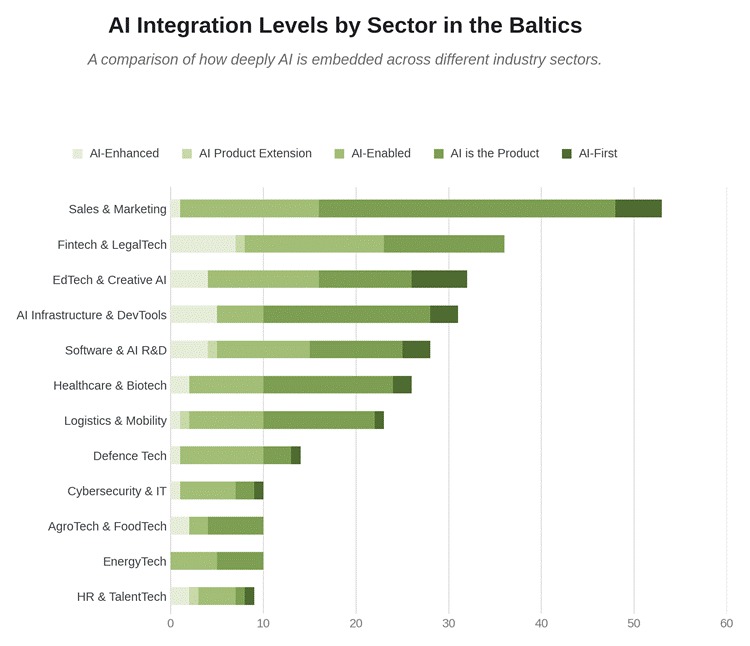
One sector went the other way. HR & TalentTech is the only category to contract, down to 9 companies with no new additions at all, and the explanation is regulatory rather than commercial. Annex III of the EU AI Act puts recruitment and workforce management in the high-risk tier: CV filtering, candidate ranking, interview scoring and promotion decisions all sit inside category 4, carrying bias-testing, documentation, human-oversight and registration duties with penalties up to €15M or 3% of global turnover. The deadline has already moved once, from 2 August 2026 to 2 December 2027 under the Digital Omnibus agreement. The nine that remain work around the regulated core: recognition tools like Peero, scheduling like Calendays.
Sector size is only half the story, though; how deeply AI sits inside the product varies sharply between them. Defence Tech is the clearest case: 9 of its 14 companies are AI-Enabled, the highest such concentration anywhere in the landscape. In defence the AI is rarely the thing being sold - it is the targeting, detection or autonomy layer inside a physical system, which is exactly what AI-Enabled describes. Milrem Robotics sells unmanned ground vehicles with the autonomy stack riding inside them; Frankenburg Technologies sells interceptors, with the AI in the guidance; Defendec sells border surveillance, with the AI doing the detection. Logistics & Mobility behaves the same way, with 20 of its 23 companies in the two deepest tiers - a Starship delivery robot is not sold as an AI product, but it does not exist without one.
At the opposite extreme sits Fintech & LegalTech, which carries the largest AI-Enhanced contingent of any sector (7 of 36) alongside a strong AI-is-the-Product core - the signature of a sector where incumbent banks and law firms are bolting AI onto established products while startups build AI-native ones beside them. Sales & Marketing is the most single-minded of the large sectors: 32 of its 53 companies sell AI as the product itself, the highest absolute count in any category, and just one sits in AI-Enhanced.
Founding Trends
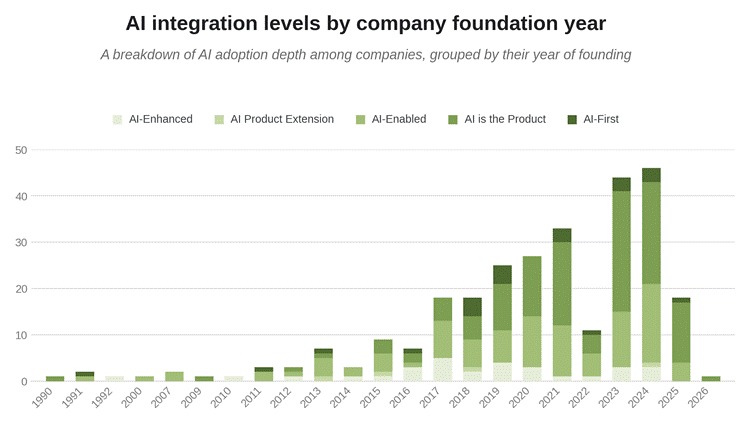
The number of new AI companies founded each year has continued its upward climb: 2021 saw 33 new companies, before a data-collection dip in 2022 (11), followed by a sharp rebound to 44 in 2023 and 46 in 2024 - both well above what last year's report recorded at the time (39 for 2023, and a partial 20 for 2024, a figure that has since more than doubled). This validates last year's own prediction: the lower counts we saw for the most recent years weren't a real slowdown, just a data lag as newer companies hadn't yet been public.
That same pattern is likely repeating itself this year - 2025 shows only 18 new companies and 2026 shows just 1 so far. We'd expect the numbers to rise as this year's newest ventures are identified and added to the landscape in the months ahead. The 2023-2024 peak is also where AI-native intensity concentrates: of the 90 companies founded across those two years, 48 are “AI is the Product” and a further 6 are AI-First.
The more useful question is why the curve bends upward at all. The answer is less about enthusiasm than about three things becoming available at roughly the same time: compute, capital and a route to market.
On compute, the region has moved from renting to hosting. Lithuania won EuroHPC backing for LitAI, a €130M AI factory led by Vilnius University with €65M in EU co-financing - the only facility of that scale in the Baltics. Latvia followed with an AI Factory Antenna (€8.4M, led by Riga Technical University) tying it into the LUMI consortium in Finland that Estonia had already joined, and all three governments, with Poland, have put their names to a proposed Baltic AI Gigafactory. A founder who two years ago had to buy compute abroad now has a national route to it.
On capital, the Baltic Startup Funding Report 2025 counts nine new Baltic-focused funds launched during the year carrying roughly €300M between them - three of them Latvian early-stage funds worth over €60M, aimed at a first-cheque bottleneck that had held the country back. AI took 46% of all venture capital raised in the region, out of a record €607M. On route to market, the universities anchoring the EU-funded consortia described below are where most of these founders trained, and those consortia fund early development without taking equity. None of the three is sufficient alone; together they lower the cost of starting enough to explain a curve like this one.
M&A and Funding Activity
Since last year's edition went out in June 2025, four acquisitions have involved companies on this landscape - three of them inbound from foreign strategic acquirers, and one a domestic deal.
- Vosker's acquisition of Defendec (December 2025) - the Canadian remote-monitoring group buying Estonia's border and perimeter surveillance specialist.
- Veriff's acquisition of Vespia (February 2026) - the only domestic deal of the four, taking Veriff into business verification.
- Sectra's acquisition of Oxipit AI (March 2026) - the Swedish medical-imaging group acquiring Lithuania's radiology AI company.
- Quantum Systems' acquisition of SensusQ (May 2026) - the German drone manufacturer taking Estonia's defence intelligence platform.
Surveillance, identity, medical imaging and defence intelligence all feature, and three of the four buyers are strategic acquirers from outside the region rather than financial sponsors - a pattern suggesting these companies are being bought for their technology rather than consolidated for scale.
On the private funding side, companies on this landscape disclosed 13 rounds over the same period, totalling €28.1 million at a median of €1.4M. The largest were Giraffe360 (€8.7M, March 2026), Bisly (€4.3M, August 2025), Vocal Image (€3.1M, September 2025) and WhiteBridge (€2.6M, March 2026).
Five larger raises sit above that early-stage base, and they change the shape of the picture entirely. Oxylabs took €113.6M from Warburg Pincus in July 2026 - its first outside capital in ten years, at a $3.6 billion valuation. Alongside it sat nexos.ai's €30M Series A (October 2025, co-led by Evantic Capital and Index Ventures at a €300M valuation, and later named Baltic Venture Capital Deal of the Year), Frankenburg Technologies' €30M Series A (February 2026, led by Plural with SmartCap), Handhold's €3M seed (April 2026) and Outcraft AI's €2M pre-seed (April 2026). Cast AI also raised in January 2026, taking a strategic investment from Pacific Alliance Ventures - the venture arm of Korea's Shinsegae Group - that carried it past a $1 billion valuation, though the amount was not disclosed and is therefore not counted below.
Taken together, the disclosed figures come to roughly €207 million since last June - and the distribution is extreme. The single largest round accounts for more than half of it, and the three biggest deals for over 80%. That is the signature of an ecosystem with a broad early-stage base and a very thin top: a few companies have reached growth stage, while almost everything else is still raising under €5M. The gap in between is where the next few years will be decided.
EU Funding
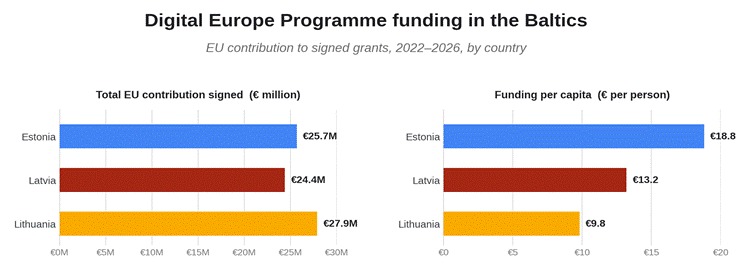
A striking share of the region's AI activity now runs through the Digital Europe Programme (DIGITAL) - the EU's deployment arm for AI, supercomputing and cybersecurity. Across 2022–2026, Baltic organisations pulled in €78.0 million across 194 organisations and 387 participations, and many of the projects behind those numbers are explicitly AI-focused.
On absolute totals the ranking flips relative to company counts. Lithuania leads with €27.9M, ahead of Estonia's €25.7M and Latvia's €24.4M - a tight three-way race. Per capita, though, the familiar order returns: Estonia draws €18.8 per person, versus €13.2 for Latvia and just €9.8 for Lithuania. The EU funding rate sits at 51–55% everywhere - exactly what you'd expect from a deployment programme built on co-financing rather than a research grant scheme.
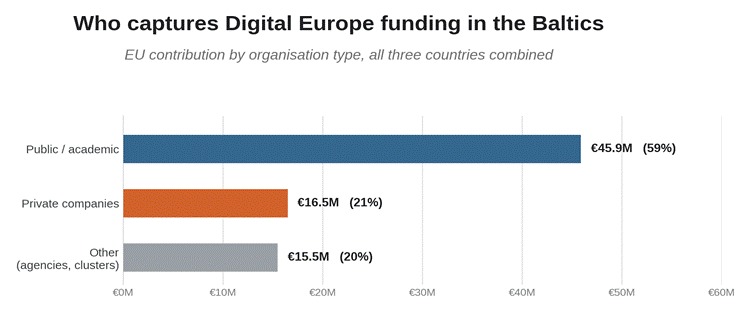
The public-versus-private split is the real headline. Universities, research bodies and public agencies captured 58.9% of all funding (€45.9M), while private companies - 72 of them, almost as many firms as the entire public side - took only 21.2% (€16.5M). And the gap is about role, not just size: public and academic players led 20 of the region's 33 Baltic-run consortia, while private firms coordinated just 3 of their 98 participations.
In short, companies show up everywhere but rarely drive. They join nearly as many projects as academia, yet sit as partners rather than leads and win a smaller average award - about €168,500 per participation against €232,000 for public and academic participants. The “other” category - innovation agencies, IT clusters and science parks like Tallinn's Tehnopol or the Latvian IT Cluster - is under a fifth of the money but posts the highest coordination rate of all (11.0%), punching well above its funding weight when it comes to actually running projects.
It would be easy to read that as Baltic companies being relegated to the back seat. The opposite case is stronger. Coordinating a consortium is administrative work - reporting, partner management, audit - that a twenty-person company has no reason to want. Participating is where the value sits, for three reasons.
- The development is paid for, and the IP is not. EU grant agreements leave ownership of results with the beneficiary that generates them; partners get defined access rights, not title. A small company can therefore have a majority of a development programme covered by public money and still own what it builds, and license it commercially afterwards. For a company that would otherwise fund that work by selling equity, the difference is substantial.
- Participation compounds into a track record. Consortium selection weighs demonstrated capacity to deliver. Each completed project makes the next application stronger, and enough of them qualify a company to lead rather than join - which is how the region's three technical universities came to coordinate 20 of 33 Baltic-run consortia in the first place. The €168,500 average award per private participation is not a ceiling; it is an entry ticket.
- The room itself is the asset. These consortia put small Baltic firms alongside national research institutes and large European partners, on projects they could not have reached commercially. That access - to problems, to procurement routes, to collaborators - is difficult to buy at any price.
The gap worth closing, then, is not that companies fail to coordinate. It is how few are in the programme at all, against a public and academic side of comparable size but far greater funding. The route in is well-trodden and the terms are favourable; the number of Baltic AI companies using it is still small.
At the organisation level, national technical universities anchor each country: Tallinn University of Technology tops Estonia (€6.1M across 17 participations), Riga Technical University leads Latvia (€4.8M), and Vilnius Gediminas Technical University leads Lithuania (€3.2M). The largest non-university names reflect DIGITAL's tilt toward infrastructure and cybersecurity - Lithuania's NRD Cyber Security (€2.8M, and one of the few private coordinators) and LVRTC (€2.4M), the state-owned operator of Latvia's broadcasting and data-transmission network. Tilde appears at smaller scale (€0.92M). Beyond those, private participation is spread thinly across a long tail of single-grant recipients - the clearest sign that the private AI sector's DIGITAL footprint is still young.
Conclusion
The Baltic AI ecosystem has grown significantly over the past year, in company count and in the depth of AI integration across offerings. What the numbers describe is a region that has specialised: each country now leads a sector that reflects the industry it had before AI arrived, and the constraints that matter are increasingly regulatory and infrastructural rather than a shortage of founders. Several trends define this year's landscape:
- The region now hosts 282 AI companies, up 53% from the 184 mapped last year, with 115 companies added and 17 removed. Part of that reflects real formation and part improved coverage; the capabilities of open-source models and integrations have also developed significantly, opening more possibilities for new ideas.
- Fintech & LegalTech (36) and AI Infrastructure & DevTools (31) have emerged as major new centres of gravity, alongside the continued dominance of Sales & Marketing (53).
- Defence Tech has more than doubled to 14 companies, and sits deeper in the stack than any other sector - 9 of the 14 embed AI inside hardware rather than selling it directly.
- The founding curve is being driven by compute, capital and university routes to market arriving together: the €130M LitAI factory, Latvia's AI Factory Antenna, Estonia's LUMI access, nine new Baltic funds in 2025 and AI taking 46% of the region's venture capital.
- Estonia continues to lead in both absolute company count (113) and funding per capita, while Lithuania has shown the fastest relative growth, up 80% from 41 companies to 74 - nearly doubling year-on-year.
- The AI-Enhanced category more than tripled (9 → 30), and the combined “AI is the Product” plus “AI-Enabled” share slipped from 85% to 80% - both signs that AI adoption is broadening beyond AI-native startups into established companies retrofitting existing products.
- HR & TalentTech was the only sector to contract, down to 9 companies with no new additions - a direct consequence of the EU AI Act's high-risk classification of recruitment and workforce-management systems, and of a compliance deadline that has now moved to December 2027.
Looking ahead, the direction of travel is clear. A landscape growing this fast is exactly the kind that produces breakout companies, and Lithuania produced two inside a single year - its fifth and sixth unicorns, one crossing $1 billion in January and the other reaching $3.6 billion in July after a decade bootstrapped. With record numbers of new AI ventures still working their way onto the map, more names are likely to follow.
EU funding will be a decisive part of that story, and the most actionable finding in this report concerns who uses it. The Digital Europe Programme is already channelling meaningful money into Baltic AI, and over the long term it does more than fund individual projects: it builds the talent, the compute and the research base the next generation of companies will draw on. But for an individual company the case is more immediate than that. A consortium place can cover a large share of a development programme with public money while leaving the resulting IP in the company's hands to license on, and each project completed makes the next one easier to win - until a firm that started as a junior partner is qualified to lead.
Only 72 Baltic private companies are currently in the programme. For a region with 282 AI companies and a compute base expanding as quickly as this one, that is the clearest piece of headroom on the board.
Authors: Analyst at Venture Faculty, Tomass Vilks, Co-founder and CEO of ProposalPeak, Edgars Poga