The Latvian Fintech Landscape Update 2026
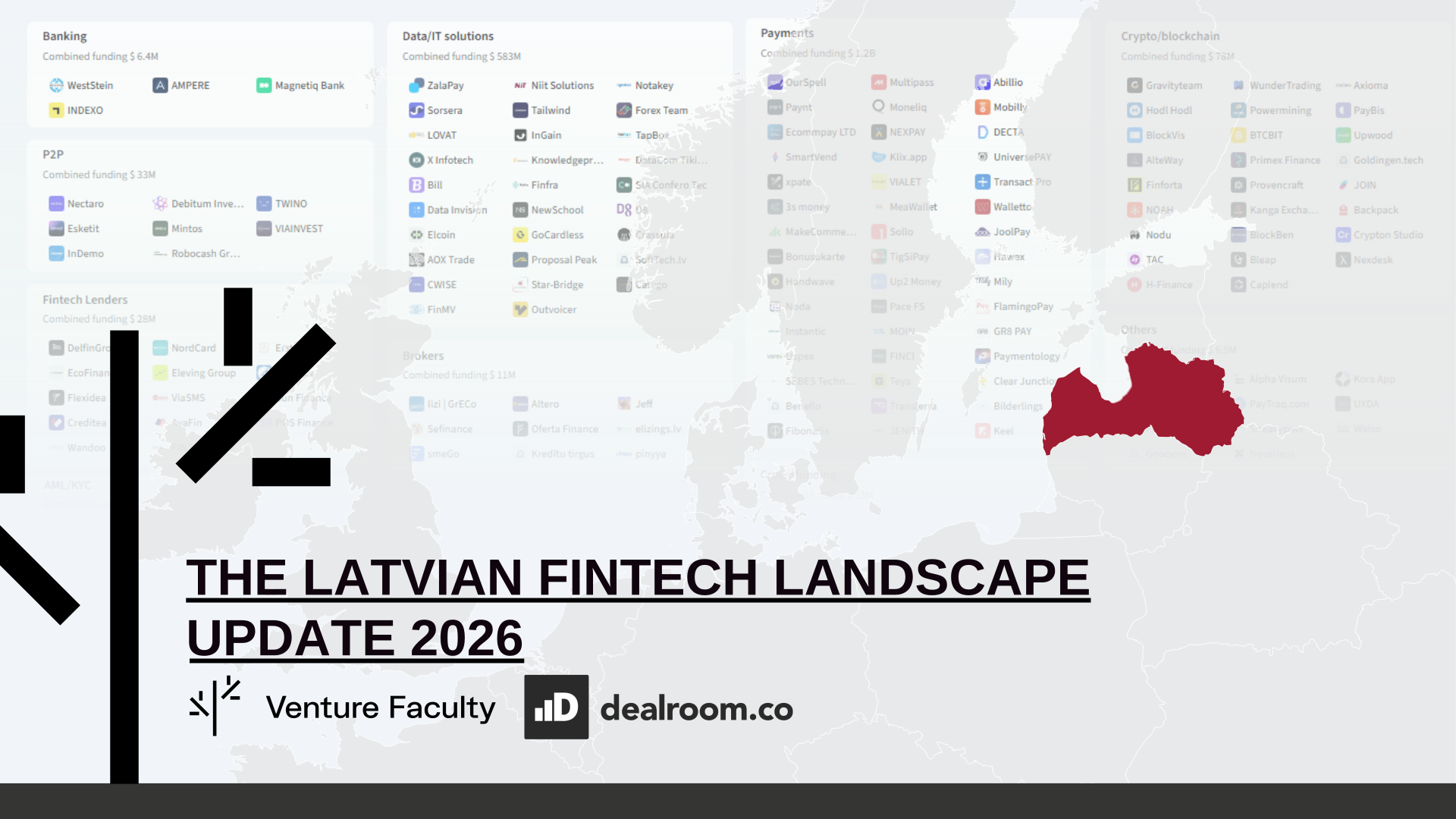
Latvia's fintech sector continues to strengthen its position on the European stage, and 2026 has been a year of both growth and maturity. The 2026 landscape includes 164 companies - up from 149 last year - and the financial data of fintech companies registered in Latvia shows revenue, profit, taxes and jobs rising every year since 2022. At the same time, 2026 was a year of regulation: the EU's MiCA licensing regime came fully into force, Latvia introduced a lighter bank licence for growing fintechs, and lawmakers decided to move the supervision of non-bank lenders to Latvijas Banka.
For the sixth consecutive year, Venture Faculty, in collaboration with Dealroom, presents this annual update, capturing the companies, deals, licences and financial data that shape Latvia's fintech landscape. This year's update covers who is on the map, how the sector performs financially, the year's main deals, what changed in regulation, and where Latvia's fintech strategy is heading.
The main message of this year's report is simple: Latvia's fintech ecosystem is growing up. It is no longer only a startup scene - it is becoming a regulated, international industry, where both local founders and international groups choose Latvia as the place to build, license and scale their business.
Methodology: who is on the map
The landscape covers active companies that use technology to provide or support financial services and challenge the traditional finance industries - from payments, lending and crypto to software, data and compliance tools - and that have a clear link to Latvia: they are registered here (including subsidiaries and branches of foreign groups), hold a licence from Latvijas Banka, run a team or office in Latvia, or were founded by Latvians. The company list is prepared together with Dealroom and each company is placed in one of ten sectors based on its main product.
Snapshot of the developing landscape
Latvia's fintech landscape now features 164 companies, compared with 149 in last year's update. 45 companies are new on the map, while 119 carried over from last year - some of them under a new name, after an acquisition or in a different category. Around 30 companies left the map because they closed, merged, moved their operations out of Latvia or no longer fit the fintech scope. A net growth of roughly 10% in a single year is a good sign for the Latvian Fintech Sector Development Strategy 2026-2027, approved by the Cabinet of Ministers in December 2025, which aims for a 30% increase in the number of fintech companies registered in Latvia, together with a 15% rise in investment and 18% growth in employment.
The new companies are spread across all 10 main sectors of the landscape, and a large share of them sit in Payments and Crypto/Blockchain. The chart below shows how the 2026 landscape is divided between the sectors and how each sector's share has changed compared with 2025.
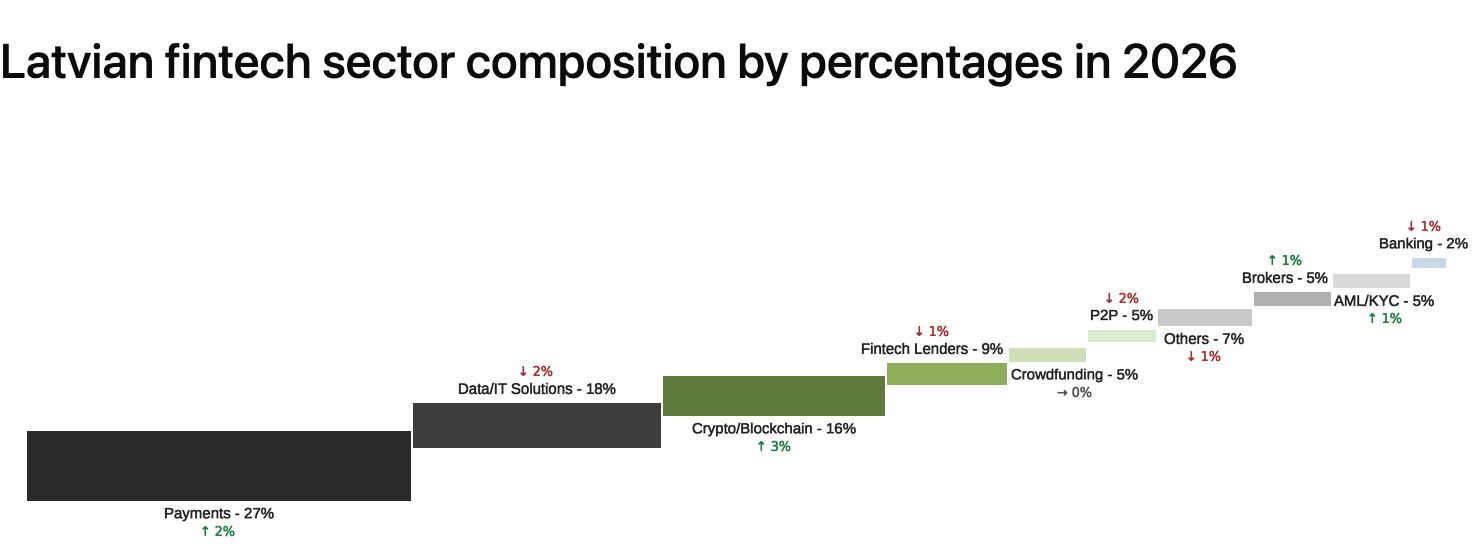
Payments (27%) and Data/IT Solutions (18%) remain the two largest sectors and together make up 45% of the entire ecosystem - the same share as last year. Payments also added the most newcomers - 14 of the 45 - while Data/IT Solutions lost two percentages of its share. Crypto/Blockchain is now firmly the third-largest sector with 16%, up three percentages from 2025 - the biggest increase of any sector. Roughly a quarter of this year's new entrants (11 of 45) are crypto companies, a direct result of Latvia's MiCA licensing wave, which gives the sector more long-term stability and trust.
Fintech Lenders (9%) remain the fourth-largest sector. Together, these four largest segments make up more than two-thirds of the ecosystem, while the remaining six sectors account for around 30% of the 164 fintechs - a landscape that is wide in scope but concentrated at the top.
Despite this concentration, the six smaller niches remain essential to the ecosystem's structure. Others (7%) brings together specialised fintechs that do not fit a single category. Crowdfunding (5%) and P2P (5%) represent alternative ways to invest and borrow alongside traditional lending, while Brokers (5%) and Banking (2%) connect fintech with traditional finance. AML/KYC (5%) provides the compliance tools that a regulated market needs. Both AML/KYC and Brokers increased their share this year, reflecting the stronger focus on regulation and investment services. Together, these segments diversify the landscape and provide the operational depth needed to support the broader financial ecosystem.
The financial footprint of the sector
From a financial point of view, the fintech sector's real footprint extends well beyond the number of companies - it shows in the revenue generated, the jobs supported and the taxes contributed to the state budget. Revenue and net profit come from the companies' annual reports, while taxes paid and the number of employees come from the State Revenue Service (VID). Where a 2025 annual report had not yet been published, the latest available figures were used, and because the company list and the data have been updated, the figures for 2022-2024 are restated and differ from last year's update. The chart below shows how much economic weight the industry now carries.
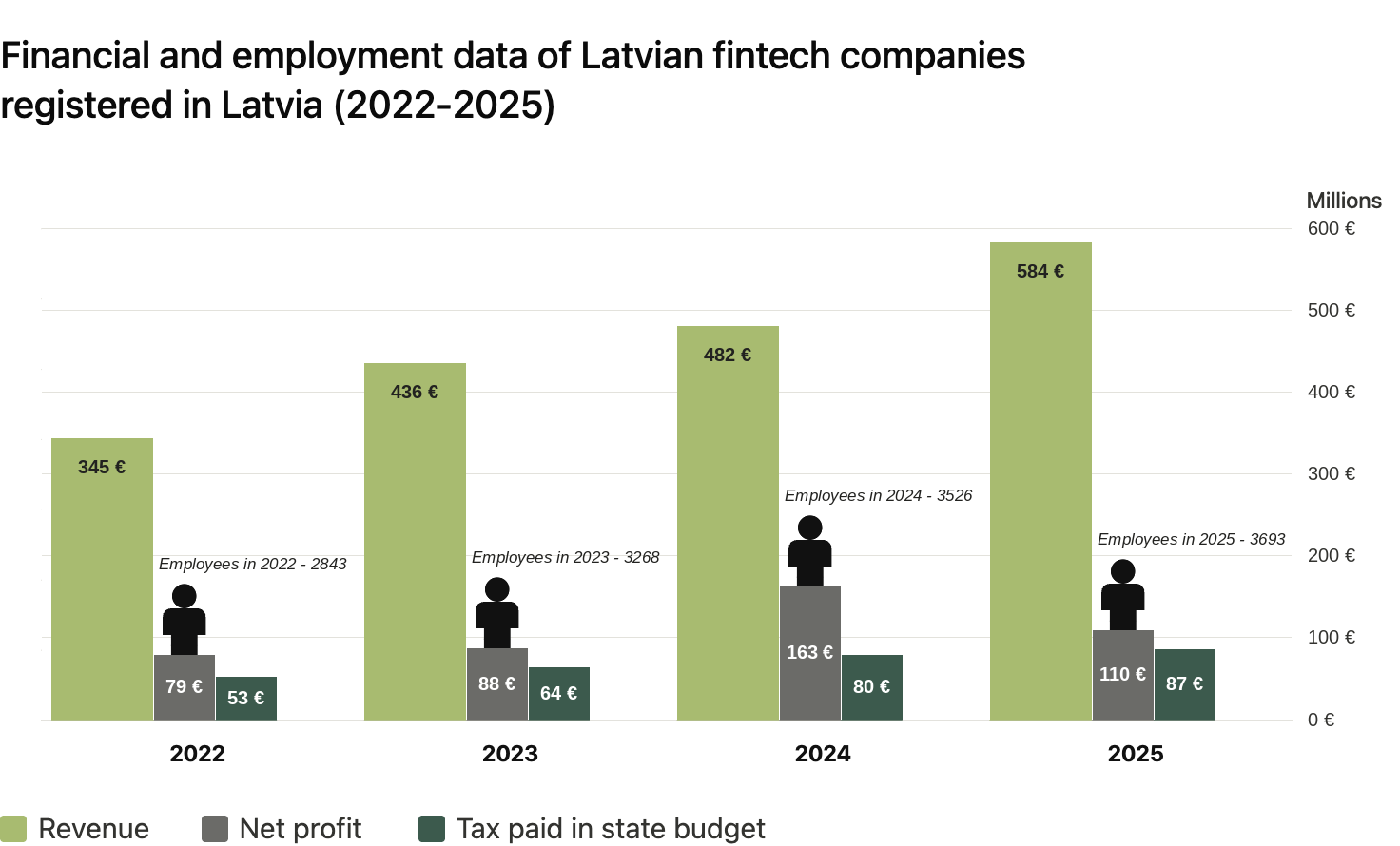
Between 2022 and 2025, total revenue rose from €345 million to €584 million, a jump of 69% in just three years. Over the same period, net profit grew from €79 million to €110 million, an increase of 40%. The peak of €163 million in 2024 is explained by a one-off result at 4finance (see the note above); without it, net profit grew every year - from €67 million in 2022 to €106 million in 2025. Tax contributions to the state budget climbed from €53 million to €87 million, an increase of 66%, confirming fintech's growing role in Latvia's public finances. Revenue, taxes and employment grew every single year.
The fintech workforce also expanded from 2,843 employees in 2022 to 3,693 in 2025 - a 30% increase, or around 850 new jobs. The companies are not only hiring more people; each employee is also creating more value. Revenue per employee rose from around €121,000 in 2022 to €158,000 in 2025, and taxes paid per employee grew from about €18,500 to €23,700 - a clear signal that productivity in the sector continues to rise.
These numbers make fintech one of the most productive parts of the Latvian economy. In 2025, every fintech employee generated on average around €158,000 in revenue - almost seven times Latvia's GDP per capita, which was about €23,400 in 2025. Each employee also brought around €23,700 in taxes to the state budget - about as much as the entire GDP per capita.
There are clear reasons why so many founders and international groups choose Latvia:
- Favourable regulation: Latvijas Banka is known as an open and accessible regulator, it offers pre-licensing consultations that help companies prepare their applications, and it has built a clear and predictable licensing process - it issued eight licences to fintech companies in 2025 and, at the time of writing, more than 20 in 2026 alone - to payment and e-money institutions, crowdfunding platforms, investment firms and crypto-asset service providers. The national fintech strategy also foresees wider use of English in the supervisors' communication with foreign companies.
- Good tax environment: under Latvia's corporate income tax model, profit that a company reinvests is not taxed - tax is paid only when profit is distributed, which suits growing companies that put their earnings back into product and people.
- Great talent: Latvia has a strong pool of IT, finance and compliance specialists, many of them multilingual and experienced in banks, payment companies and global tech teams, at costs that remain competitive within the EU.
It's important to note what this data does and doesn't capture. These figures only reflect companies with a legal entity registered in Latvia - a meaningful share of the ecosystem falls outside that scope. A number of Latvian-founded fintechs run their core operations through holding structures or subsidiaries based elsewhere, meaning that part of their revenue, headcount and taxes is recorded in other countries' statistics, even when the product, the team or the strategic decisions remain rooted in Latvia.
A second factor is also worth considering: fintech remains, at its core, a growth-stage industry. A mature, profitable company and a fast-scaling startup can look very different on a balance sheet even when both are performing well - one is optimising for margin, while the other is reinvesting heavily in product, hiring and market expansion. Strong revenue growth alongside thinner profit in some companies is therefore not necessarily a sign of underperformance; it often reflects the natural pattern of fast scaling.
Taken together, these two factors suggest that the figures above understate the sector's true size. Accounting for companies registered abroad and the value that is still being built but has not yet turned into profit, Latvia's actual fintech footprint is clearly larger than what domestic financial statements alone can show.
Deals, growth and international reach
The Latvian fintech industry continues to grow, and with it come the investment, deals and international recognition of a sector that is no longer in its early stages. In 2026, both international players and Latvian groups were active buyers, investors kept financing local companies, and Latvian fintechs continued to expand abroad.
Mergers and Acquisitions: Consolidation in Both Directions
M&A activity in 2026 reflects a maturing market moving on two fronts - international players acquiring established companies with Latvian roots, while domestic groups consolidate to build scale at home.
- 4Finance - On 29 May 2026, a management-led consortium headed by 4finance Holding chairman Kieran Donnelly agreed to acquire 4finance Holding's core consumer lending business, following the sale of tbi Bank. The business now operates as Mellenu Holding, active in 11 countries - and it all started in Latvia in 2008. In Latvia, the Mellenu team counts around 180 people.
- GoCardless - The Amsterdam-based payments company Mollie agreed in December 2025 to acquire GoCardless for about €1.05 billion and completed the deal on 1 September 2026. GoCardless continues to operate as "GoCardless, a Mollie company", and the combined group serves more than 350,000 businesses. GoCardless's Riga team grew out of the Latvian open banking startup Nordigen, which GoCardless acquired in 2022.
- INDEXO / VAIRO / DelfinGroup - On 26 January 2026, INDEXO completed its share buyback offer and acquired 71.52% of DelfinGroup, later increasing its stake to 72.07%. The aim is to build a strong, locally owned Latvian financial group and use DelfinGroup's profitability to support the growth of INDEXO Bank. VAIRO, acquired in 2025, was renamed INDEXO Asset Management IPAS, and in August 2026 INDEXO announced that it will move its entire pension business into this company, with IPAS INDEXO becoming the group's parent company.
- Creditea - On 4 August 2026, the US specialty finance group BasePoint Capital completed its £543 million takeover of International Personal Finance (IPF), the group behind the Latvian digital lender Creditea. The deal, agreed in December 2025, took IPF - which serves around 1.7 million customers in nine countries - private after nearly two decades on the London Stock Exchange.
Raising Capital: Investors Keep Backing the Sector
Latvian fintechs also continued to raise capital from both retail and institutional investors, often through the local capital market:
- INDEXO raised €4.95 million from 454 investors in the share issue that accompanied its DelfinGroup offer, to finance the deal and the development of INDEXO Bank, and its subsidiary INDEXO Bank raised a further €5 million through subordinated (Tier 2) bonds in April 2026.
- DelfinGroup reported revenue of €78.2 million for 2025, up 24%, with profit before tax up 35% to €12.4 million, and its shareholders approved a new bond issue of up to €45 million to fund further growth.
- Eleving Group priced a new €200 million senior secured bond at 9% in a private placement on 1 October 2026, to be listed on Nasdaq Riga and the Frankfurt Stock Exchange. This follows the €275 million bond issue in October 2025 - the largest public bond issue in the group's history.
- Sun Finance placed a new €50 million bond with a 10% coupon in autumn 2025 to refinance earlier notes and fund further expansion. The group reported 2025 revenue of €287 million, grew its loan portfolio by 27% in the first quarter of 2026, and in April passed €5 billion in loans issued since its start in 2017.
International Reach: Scaling Abroad
As Latvian fintechs mature, their ambitions increasingly reach beyond national borders - entering new markets and scaling partnerships across continents. The examples below show how far that reach now extends, from Central Europe to South America and Asia.
- Regula is helping Uber build a nationwide driver verification network in Poland. The June 2026 expansion added mobile document readers alongside the verification centres Uber has used since 2024, extending the same fraud-detection checks to new cities without full verification infrastructure.
- Wandoo Finance, a Latvian digital lending group operating in Poland, Spain, Romania and Peru, increased its revenue by 77% to €61.5 million in 2025 and its net profit by 78% to €3.6 million, according to its consolidated annual report - showing how Latvian lenders continue to grow far beyond their home market.
- DECTA expanded its Fintech Fast Track programme to Asia-Pacific and launched it at the Singapore FinTech Festival in November 2025. The programme, previously offered only in Europe, gives selected card issuers and acquirers access to DECTA's payment infrastructure with zero set-up costs and up to €100,000 in implementation value.
Recognition Across the Sectors
International recognition in 2026 also spanned several sectors. In June, three companies from the landscape - DECTA, Ecommpay and Paymentology - were named to the Payments Power 50 2026, The Power 50's annual list of 40 companies and 10 leaders shaping the global payments industry. Crassula, a Latvian white-label digital banking platform, was named among the winners of Wealth & Finance International's FinTech Awards 2026. This shows that recognition now spans multiple sectors - not just the largest segments of the landscape.
Legal and regulatory changes
Behind the growth, deals and recognition described above stands a regulatory environment that changed significantly in 2026. Three changes stand out: the MiCA licensing wave in crypto, a new and lighter bank licence, and the decision to move the supervision of non-bank lenders to Latvijas Banka. Together, they show a country that is raising its standards while keeping the door open for new companies.
MiCA: The Licensing Wave Reshaping Crypto
MiCA was the biggest regulatory story of the year, and its effect on the crypto sector has been significant. MiCA stands for Markets in Crypto-Assets - the European Union's common legal framework for the issuing, trading and custody of crypto-assets. It was introduced in stages: the regulation entered into force in June 2023, the rules for stablecoins started to apply in mid-2024, and the licensing regime for crypto-asset service providers (CASPs) took effect on 30 December 2024. Firms that already operated under national rules could continue working temporarily while their MiCA application was reviewed - a transition period that each EU member state could set for up to 18 months.
Latvia chose one of the shortest transition periods in the EU - just six months, ending on 30 June 2025. The final EU-wide deadline came on 1 July 2026: after that date, no crypto company anywhere in the 27 member states could operate without a MiCA licence.
Latvia used this period well. By the end of September 2026, Latvijas Banka had granted MiCA authorisation to 12 companies, including BlockBen and Nexdesk in December 2025, followed by PayBis, Neverless and Backpack Exchange EU in May 2026, TWINO, Kanga Exchange EU, Bleap and Hfinance in June, Nodu in July and Noah at the end of September. Several companies received a payment institution licence at the same time: PayBis was the first crypto company in Latvia to get both licences at once, and Backpack Exchange EU, Nodu and Noah followed the same path. In addition, the e-money institution GR8 PAY, licensed in December 2025, is listed in the EU's official register of e-money token (stablecoin) issuers.
Many other firms could not get their licence before the deadline, because the bar is fundamentally higher than before. MiCA authorisation is a much heavier process than the national VASP (Virtual Asset Service Provider) registration it replaced, which was largely a paperwork exercise. CASP authorisation instead requires proven governance, capital reserves matched to the specific services offered, documented operations and a qualified compliance officer.
A New Path to Banking: The Specialised Bank Licence
The second big change is a new, lighter bank licence. Amendments to the Credit Institution Law, adopted by the Saeima on 11 December 2025 and in force since 6 January 2026, introduced a specialised credit institution with a minimum initial capital of €1 million, instead of the standard €5 million for a bank. Such institutions can take deposits, issue loans and offer leasing, payment, investment and crypto-asset services across the EU. The licence is designed for fintechs that have outgrown an e-money or payment institution licence, and it follows a model that Lithuania has used since 2017, where several fintech companies have grown into licensed banks. For the most ambitious fintechs on the map, this opens a realistic path from payments to full digital banking - without leaving Latvia.
Non-Bank Lending Moves Under Latvijas Banka
The third change ends a long debate between the industry and lawmakers. Latvia's non-bank consumer lending market keeps growing: in 2025, lenders issued a record of more than €1 billion in new loans, and the total loan portfolio exceeded €1.4 billion. So far, the sector has been supervised mainly by the Consumer Rights Protection Centre (PTAC), while Latvijas Banka and the State Revenue Service also played a role. In practice, the same company could face three supervisors, parallel inspections and different requirements.
The reformers wanted a unified, professional financial supervision system, arguing that a general consumer protection agency - one that also checks the safety of products such as toys - is spread too thin to oversee complex financial services. The government backed the reform on 17 March 2026. The other side raised concerns: PTAC itself wanted to keep the function, the Fintech Latvia Association asked for the change to start only in 2028, and the Ministry of Economics warned that it would reduce state budget revenue by about €1.5 million a year and double the cost of supervision.
After months of discussion, the Saeima adopted a package of 13 laws in the final reading on 17 September 2026. From 1 January 2027, Latvijas Banka will take over the licensing and supervision of non-bank consumer lenders from PTAC, together with consumer protection for the whole financial sector - first applying PTAC's existing guidelines, with full supervision under its own rules from 2028. Latvijas Banka has said it will take a systemic approach instead of reacting to complaints after the harm is done, and it will prepare the new rules together with the Fintech Latvia Association and market participants to ensure a smooth transition. For the lending sector, this means one supervisor and clearer rules - which can also strengthen the trust of investors who finance lenders through bonds and P2P platforms.
Recognised Compliance Standards
Latvia's compliance credentials have also been formally recognised. The Financial Intelligence Unit of Latvia reports that the country received a Moneyval assessment, published in February 2026, confirming its effectiveness in combating financial crime. The evaluation highlights a robust, well-coordinated and highly effective system for combating money laundering, terrorist financing and proliferation financing. According to Latvijas Banka, this strong result has also increased international companies' interest in getting licensed in Latvia - a clear example of how good regulation supports business.
Latvia's fintech strategy: clear goals for 2027
On 22 December 2025, the Cabinet of Ministers approved the Latvian Fintech Sector Development Strategy 2026-2027, prepared by the Ministry of Finance together with Latvijas Banka. The strategy sets three measurable goals: 30% more fintech companies registered in Latvia, 15% more investment and 18% more jobs in the sector. It is built on four pillars - promoting Latvia's fintech sector abroad, infrastructure and regulation, access to capital, and talent - and it also foresees wider use of English in the supervisors' communication with foreign fintech companies.
When the strategy was drafted, there were about 130 fintech companies registered in Latvia. Our landscape, which uses a broader definition, now counts 164 companies, up from 149 a year ago. The data gathered for this update also shows that employment in the companies we track grew by almost 5% in 2025 alone and by 30% since 2022, while taxes paid grew by 66% over the same period. Latvijas Banka notes that the number of licensed financial market participants is growing and that more and more payment service providers are choosing to use its payment infrastructure - while promoting Latvia's fintech sector abroad has been named one of the key action lines of the new strategy.
International interest in Latvia continues to build. Latvijas Banka has reported interest in crypto licences from Poland, Lithuania, Spain, Germany, Turkey, Canada and the United Kingdom, and Dienas Bizness reported in September 2026 that at least ten Turkish companies are interested in obtaining a MiCA licence in Latvia, following the event "Scaling from Türkiye to Europe: The MiCA Path" in Istanbul. Around a quarter of Turkey's population owns crypto, and if these companies decide to serve the Turkish diaspora across the EU from Latvia, the jobs and the taxes from these operations would stay in Latvia.
What's Next for Latvia's Fintech Ecosystem?
Latvia's fintech ecosystem has built real momentum this year. Rather than a startup scene still trying to prove itself, it is becoming a permanent and important part of the economy - an industry that is moving steadily towards its 2027 targets. The data gathered for this update tells a clear story: 164 companies on the map, 45 of them new; and, for the companies registered in Latvia, €584 million in revenue, €110 million in net profit and €87 million in taxes paid in 2025 - with revenue, taxes and jobs at their highest level in four years - together with 3,693 employees, almost a third more than in 2022.
The direction is just as important as the numbers. With more than 20 fintech licences issued in 2026 alone, 12 MiCA licences in total, a new €1 million bank licence and a single financial supervisor for non-bank lenders from 2027, Latvia is building a regulatory environment that is demanding, but open and predictable. This is exactly what international companies look for when choosing their EU base - and the growing number of international companies licensed in Latvia this year shows that more and more of them are finding it here, while local companies continue to grow at home and abroad.
MiCA, in particular, is a long-term bet. In the short term, stricter rules may slow some crypto companies down and limit the sector's flexibility. In the long run, the expectation is that fewer, better-capitalised and properly supervised companies will build a stronger and more trusted market than a larger but unregulated field. This bet will not be proven one way or the other for another year or two - but with a growing number of licensed companies, strong interest from abroad and a sector that keeps growing in revenue, profit, taxes and jobs, Latvia is well positioned to turn today's momentum into long-term leadership in Northern Europe.
Author: Analyst at Venture Faculty, Tomass Vilks